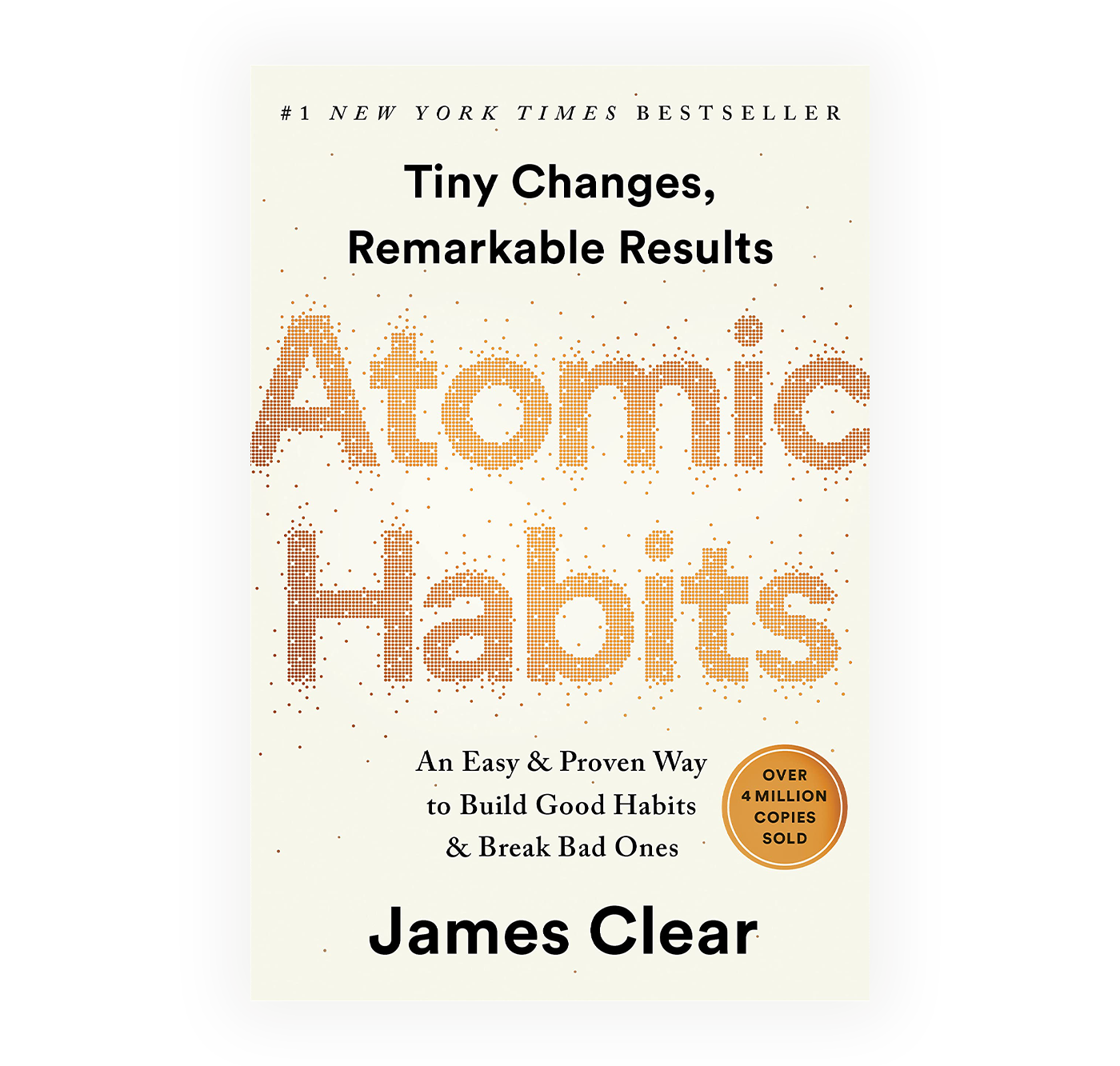
What are habits?
Habits are the compound interest of self-improvement.
And when we repeat 1% errors, day after day, through replicating poor decisions, duplicating tiny mistakes, and rationalising little excuses, our small choices compound into toxic results.
There are 4 laws of behaviour change that we can use to create good habits and break the bad ones
A single habit is made of a cue, craving, response, and reward. And these components are formed according to the 4 laws of behaviour change:
- Make it obvious – the habit needs to be effortless for us and require no active thinking. For example, when I had a hard time remembering to take my Vitamin D pills. I realised that the problem was that I kept these pills on the other side of the kitchen. Once I put them in the obvious spot that I couldn’t miss, I started taking them more regularly.
- Make it attractive – if the habit is unattractive we likely won’t have enough willpower to do it over and over. Therefore, you should come up with some ways to make the habit attractive even if it’s something hard like going to a gym or studying for long hours. For me, it was restricting my fantasy audiobooks listen-time to when I was at the gym which made the whole workout thing much more pleasurable.
- Make it easy – the less friction there is between you and the habit, the greater the chances are that you’ll actually do it. This applies to simple things like packing your gym bag a day before you want to go to the gym or preparing a healthy meal to make sure that you don’t order another takeaway.
- Make it immediately satisfying – our brain rewards immediate returns so it’s good to come up with something simple that brings us joy right after we perform our habit. Every time I go to the gym, I hop into a pool and spend 10 to 20 minutes in a spa. I know that it sounds a bit excessive but this little routine makes me much more optimistic about spending an hour or two in the gym.
It takes time to build a habit or break a bad one and that’s why most people quit halfway
Time magnifies the margin between success and failure. It will multiply whatever you feed it. Good habits make time your ally. Bad habits make time your enemy.
If you find yourself struggling to build a good habit or break a bad one, it is not because you have lost your ability to improve. It’s often because you’ve not yet crossed the Plateau of Latent Potential. Complaining about not achieving success despite working hard is like complaining about an ice cube not melting when you heated it from twenty-five to thirty-one degrees. Your work was not wasted, it’s just being stored. All the action happens at thirty-two degrees.
San Antonio Spurs, one of the most successful teams in NBA history, have a quote from social reformer Jacob Riis hanging in their locker room:
“When nothing seems to help, I go and look at a stonecutter hammering away at his rock, perhaps a hundred times without as much as a crack showing in it. Yet at the hundred and first blow it will split in two, and I know it was not that last blow that did it—but all that had gone before.”
Adopt a systems-first approach instead of focusing on goals
Goals are about the results you want to achieve. Systems are about the processes that lead to those results.
The goal in any sport is to finish with the best score, but it would be ridiculous to spend the whole game staring at the scoreboard. The only way to actually win is to get better each day. In the words of three-time Super Bowl winner Bill Walsh, “The score takes care of itself.” The same is true for other areas of life.
If you want better results, then forget about setting goals. Focus on your system instead.
Goals are good for setting a direction, but systems are best for making progress. A handful of problems arise when you spend too much time thinking about your goals and not enough time designing your systems.
A systems-first mentality provides the antidote. When you fall in love with the process rather than the product, you don’t have to wait to give yourself permission to be happy. You can be satisfied anytime your system is running. And a system can be successful in many different forms, not just the one you first envision.
The purpose of setting goals is to win the game. The purpose of building systems is to continue playing the game. True long-term thinking is goal-less thinking. It’s not about any single accomplishment. It is about the cycle of endless refinement and continuous improvement. Ultimately, it is your commitment to the process that will determine your progress